/images/9d47f29e-5eb6-4938-a9b4-0e11df364771/hclu_BLOG.png)
Meet Our Members is a series where Liberties introduces you to our network of human rights defenders. We hear the stories of the people behind the organisations and why they do the work they do. Liberties is an umbrella network which coordinates campaigns with its expanding network of national civil liberties NGOs in 21 EU Member States.
Hungary’s political airwaves are filled with a rare optimism. After 16 years of continuous dismantling of the rule of law under Fidesz’s rule, Hungary shocked the world (and itself) by voting Orban's fiercest opposition leader into office, triggering what Hungarians hope will be a historic transformation. Civil society rejoiced, amongst them Zsuzsanna Nyitray, a legal expert at the Hungarian Civil Liberties Union (HCLU) who returned to Budapest only months before the landmark election after years of living abroad.
An Unexpected Path
Zsuzsanna's decision to study law at the ELTE university in Budapest was born more out of pragmatism than passion, as law seemed a sensible and stable career path. What she didn’t anticipate was falling in love with it. International law and human rights law in particular caught her attention, and by the end of her studies, she found herself writing her dissertation on the UN Convention on the Rights of the Child.
"I really fell in love with the whole UN human rights framework”, she says, “And I was interested to see how these international conventions are put into practice in the countries themselves”.
But academia could only hold Zsuzsanna for so long. After her PhD, she felt that it was not enough to merely write about injustices; she wanted to do something about them.
Around the World and Back
Zsuzsanna joined HCLU in 2011, a tense time for the Roma minority in Hungary, following a period in which a series of killings and a sharp rise in hate speech shocked civil society into action. She decided to join HCLU’s Roma Rights Program, which focused on providing legal protection and aid to Hungary’s Roma community. From there, Zsuzsanna’s work took her across Europe and beyond, working for a variety of other global human rights organisations, a path which eventually led her back to Budapest and HCLU at a serendipitous moment.
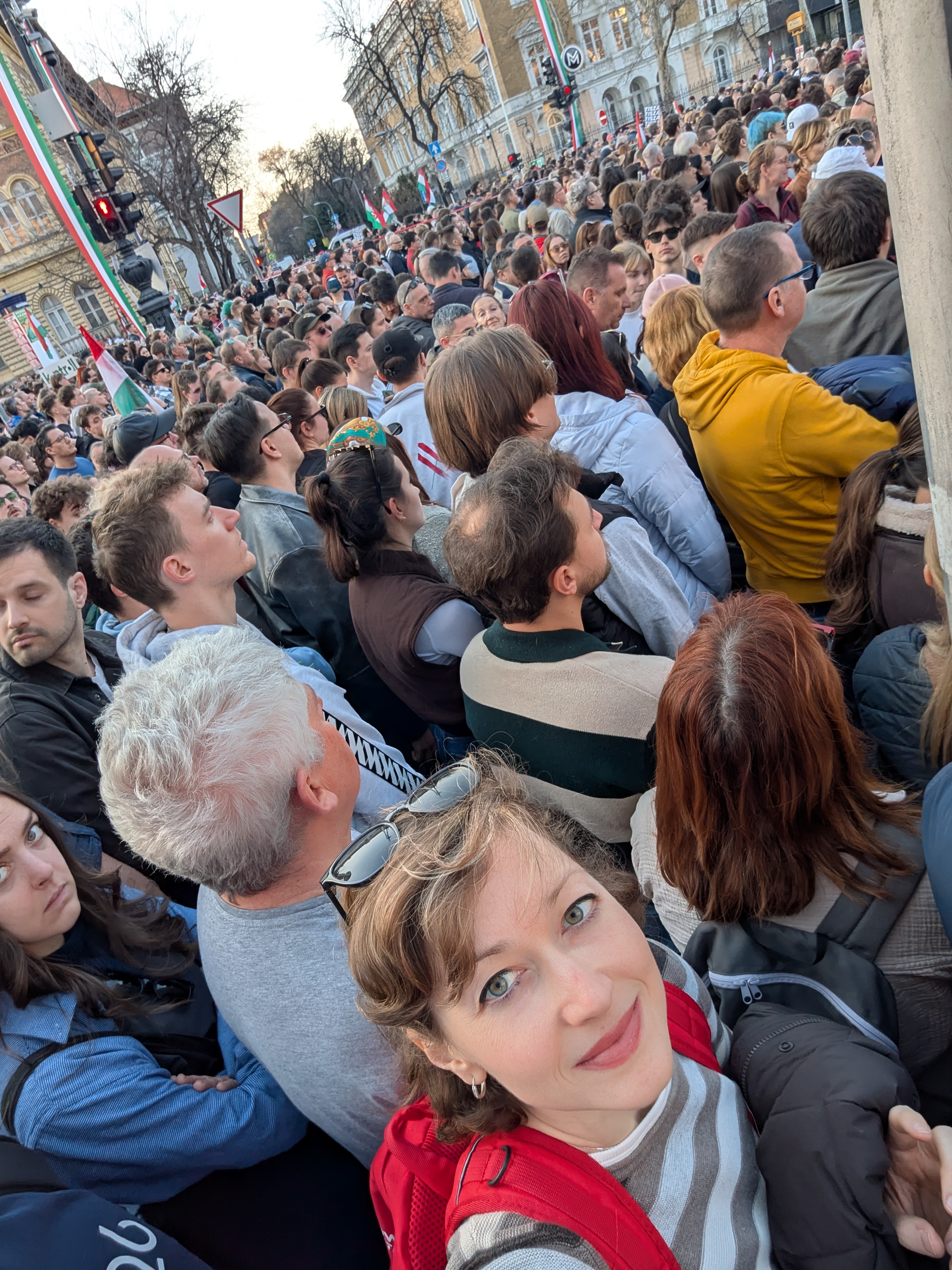
Anti-government rally led by the Tisza party on 15 March, 2026—the Hungarian commemoration day for the 1848 uprising against the Habsburgs.
Hungary’s Oldest Watchdog At a Turning Point
Founded in 1994, the Hungarian Civil Liberties Union is Hungary’s oldest human rights watchdog organisation and focuses on legal aid, strategic litigation and advocacy. Over the past 16 years, with democratic institutions having been continually dismantled under the Orban government, the organisation leaned heavily into its watchdog function. Now with a new power in office, the HCLU aims to revive their advocacy function.
Preparing for the Landslide
Planning for all possible scenarios of how the election could play out started early, Zsuzsanna tells me. All-staff meetings, careful strategising and thinking ahead. And yet, despite all the groundwork, the result still came as a surprise: “I don't think any of us were prepared for this kind of landslide”. With the best possible scenario plotted out and realised, now comes the hard work of understanding what it actually means in practice.
One immediate adjustment will be HCLU’s role with the government itself. Hungary is a fairly small country, and the world of public policy and law is even smaller. Since the elections, many of the organisation’s allies have stepped into positions of power since the new government is in office, and increasingly more people from civil society have been invited into public administration.
“We're very happy that now there's an openness to hearing those voices that civil society can bring in”. It is a good sign that democracy is finding its way back again, Zsuzsanna acknowledges, but for the HCLU, its unfamiliar territory after nearly two decades of civil society being deliberately and systematically frozen out of democratic processes and vilified by Orbán’s government.
Through all of this, one thing remains steadfast: “We’ve always been a completely impartial organisation, that very strictly refuses any government or state bonds,” she says. “ That is something that will not change.”
Being a Watchdog in an Optimistic Climate
Perhaps the trickiest domain that HCLU now has to navigate has nothing to do with litigation or funding; it is the domain of public mood. After 16 years of being united against a common adversary, Hungarian civil society is entering a new era: an era of genuine and healthy disagreement, where different organisations have different priorities and different visions for what comes next. That, Zsuzsanna is quick to point out, is a good sign. “In public, you can have different opinions, and that's a very good conversation to have. It’s an aspect of a healthy democracy.”
But this comes with communication challenges that shouldn’t be underestimated. There is genuine optimism in the air right now in Hungary, and people are emotionally invested in this new, long-awaited chapter
For a watchdog organisation, this presents a delicate balance: how do you hold a popular government to the same standards you applied to an unpopular one without being dismissed as overly critical or impossible to satisfy? Zsuzsanna’s answer is straightforward: the rules of the game, she says, are the same for everyone.
What has changed is that the HCLU is no longer writing proposals into a void. For the first time in a long time, expertise from civil society is actively sought rather than side-tracked. The task now is to make sure that this openness hardens into something more structural that paves the way for all other Hungarian civil societies to come.
How to Measure Success
Zsuzsanna’s personal view on measuring accomplishments is more modest than one would expect. She values improvements to individuals' lives over landmark victories and sweeping systemic change. She says, “Whenever there's a baby that gets home to their family from whom they've been taken away because of stereotypes against the family, because of them living in poverty. Those I feel like are achievements.”This is part of Zsuzsanna’s philosophy on how to stay grounded, “because the big systemic goals are long and the risk of losing sight of the people inside them is real.”
Staying Grounded and Switching Perspectives
Outside of work, Zsuzsanna's switching off looks reassuringly ordinary. Family comes first, her children, the wider circle of loved ones and a home that genuinely feels like a safe haven.
Beyond that, it's the physical that grounds her. Pilates, swimming and dance courses, anything that helps her to get out of her head. She’s mindful of her screen and news consumption too, making sure to stay informed, but protecting her space to rest carefully.
Travel is another anchor. Meeting people from other countries has a way of putting things in perspective, a reminder that joy and difficulty coexist everywhere. “Everyone has their problems, every community faces challenges” she reflects, “But you shouldn’t forget about the joys either. If you do, you’re not able to do this work for long."
Navigating the Dark Years
For anyone asking how to get through the dark times, Zsuzsanna’s answer is both simple hard-won: community and having faith in the long haul. “The truth comes out. If you’re working for justice and truth, it may take a very long time, but the truth will always find its way to the surface”.
And for moments when the future feels too distant, Zsuzsanna offers something else: simply bearing witness. Documenting what is happening and building an archive of an era, trusting that this will matter even when you feel like it won’t. “The work is never superfluous; there will be a point where all of this is going to matter.”
And it appears that for Hungary, that time has come.
More articles in the Meet Our Members Series
Nyt Europa, Denmark: Making Democracy Work for Everyone
Polish Helsinki Foundation For Human Rights: Human Rights Work Is Not Just A Profession
Via Iuris, Slovakia: Coming Home to Defend Democracy
/images/fd901090-2b8c-422d-9bf8-df510573598c/CILD_BLOG__1_.png)
/images/719924bf-c273-4e9a-a91f-95f086324319/nyt_europa_BLOG.png)
/images/69709852-a009-4873-8b47-a72bcce0f989/Helsinki_BLOG.png)