/images/719924bf-c273-4e9a-a91f-95f086324319/nyt_europa_BLOG.png)
Meet Our Members is a series where Liberties introduces you to our network of human rights defenders. We hear the stories of the people behind the organisations and why they do the work they do. Liberties is an umbrella network which coordinates campaigns with its expanding network of national civil liberties NGOs in 21 EU Member States.
Most people who spend their workweek navigating EU institutions and Brussels policy circles use their weekends to slow down. But not Rukiatu Sheriff. She spends her weekend organising. Alongside her work as a Rights Advisor at Nyt Europa, she is engaged in various grassroots organisations in Denmark.
To some, working at an EU advocacy organisation might seem at odds with the local focus of grassroots collectives, but to Rukiatu, they are inseparable.
Based in Copenhagen but with a Europe-wide focus, Nyt Europa was founded on a similar conviction: the EU is best changed from within. The organisation is built around three thematic areas: a wellbeing economy that respects planetary boundaries, rights and rule of law with a focus on marginalised voices, and democracy and stronger public institutions. More broadly, the organisation is centred around closing the gap between EU institutions and Danish citizens who might feel far away from what is happening in Brussels.
From Academia to EU Advocacy
Rukiatu arrived at Nyt Europa after studying international studies in Denmark for her bachelor’s degree, followed by a master's in political science in Sweden. Her studies always circled back to anti-racism, empowering marginalised voices, and making democracy work for the excluded. She joined Nyt Europa through the Fundamental Rights Initiative Project, a programme designed to help civil society organisations to use EU institutions to understand their civil rights and pressure governments, while also providing grants to both formal civil society and grassroots organisations to support their work directly.
More recently, Rukiatu has focused on Europe's increasingly restrictive migration agenda and what it means for democracy, fundamental rights and the rule of law. Through her advocacy, she has challenged the direction of both Danish and European migration policy, arguing that the normalisation of detention, deportation and deterrence risks undermining the very values Europe claims to uphold. She has been particularly critical of the migration agenda championed by Prime Minister Mette Frederiksen, questioning how Denmark's growing influence on EU migration policy is reshaping Europe's commitment to human rights.
Rukiatu hosting a workshop at Reclaiming Climate Justice summit hosted by Systemic Justice in Denmark
After Hours Organising
The grassroots organisations focus on anti-racism, climate justice and recognising how the climate crisis intersects and exacerbates existing injustices.
“I truly believe it's important to work with the people who are trying to come up with alternatives,” she says.
She works, among others, with the Collective Against Environmental Racism, a Danish grassroots organisation that campaigns against the demolition of social housing in migrant communities and draws attention to the climate consequences of demolishing housing, previously a hardly-talked-about topic.
Her grassroots work is an essential counterweight to the work she does within the framework of a civil society and reflects her broader philosophy that we need to work both within and outside the system to achieve meaningful change. It's also why the Fundamental Rights Initiative resonated so personally; the re-granting it provided to grassroots organisations directly supports the kind of work she does outside office hours.
The Cost of Proximity to Power
Putting this philosophy into practice also comes with challenges.: To change systemic injustices, you need proximity to power, but sometimes this power belongs to people actively undermining the values you’re fighting for. In reality, this often means sitting at the same table as right-wing politicians whose politics threaten the people you represent and having tough conversations on how to move forward. Rukiatu advises that “You have to be pragmatic”. She advocates for finding the middle ground and balancing allyship with progress, recognising that “if you don't go close enough, you don't have influence.“

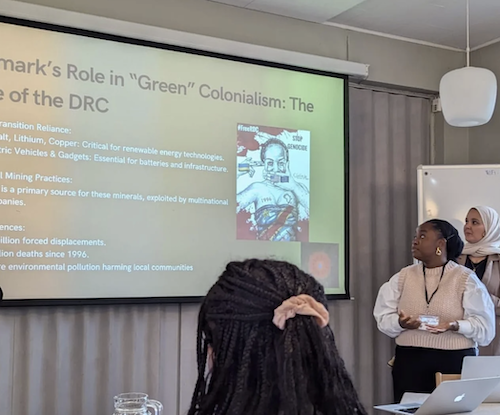
Rukiatu attending Climate Justice Days where she sat on the panel: Green colonialism in the Democratic Republic of Congo: The dark side of the green transition.
Speaking Truth to Power
When asked what helps her unwind after the balancing act of institutional work, she returns to her grassroots work:“I also need to do something that challenges the system, and by doing something that challenges the system, it lightens my heart in a way.” Rukiatu firmly believes that grassroots work is valuable because it creates small spaces of community where alternative thinking can flourish, and radical visions for the future can emerge.
This is what keeps Rukiatu going. Strong friendships, honest venting, and above all, the grassroots community, which Rukiatu describes as a “warm hug”, a “space of dreams”, and a place to practice innovative thinking and collectivism that formal systems can never fully accommodate.
When asked about advice on how to not lose hope, she says: “You have to have the audacity to challenge the system.” This means being brave and not backing down, despite the consequences.
Her view stands out in a landscape where civil society organisations face difficult trade-offs between financial sustainability and bold advocacy. Rukiatu believes that a genuine commitment to the communities they serve should be the “guiding Northstar” of civil society organisations, something that is reflected in every piece of work that is produced.
For Rukiatu, that conviction did not come from institutional work; it came from the grassroots. “This is something that being in grassroots spaces has taught me, to not be afraid to speak truth to power”.
More articles in the Meet Our Members Series
Polish Helsinki Foundation For Human Rights: Human Rights Work Is Not Just A Profession
Via Iuris, Slovakia: Coming Home to Defend Democracy
GFF, Germany: From Conviction to Court Cases: When Activism Meets the Law
/images/fd901090-2b8c-422d-9bf8-df510573598c/CILD_BLOG__1_.png)
/images/9d47f29e-5eb6-4938-a9b4-0e11df364771/hclu_BLOG.png)
/images/69709852-a009-4873-8b47-a72bcce0f989/Helsinki_BLOG.png)